#puzzle
Power Tower
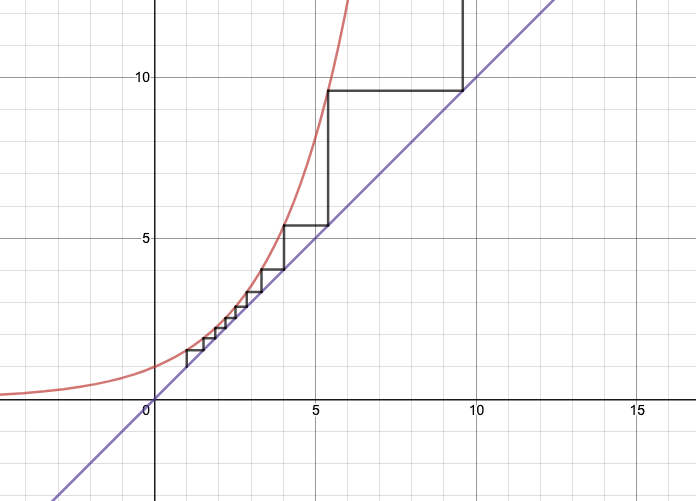 Figure 1: Power Tower for \(b = 1.52\)
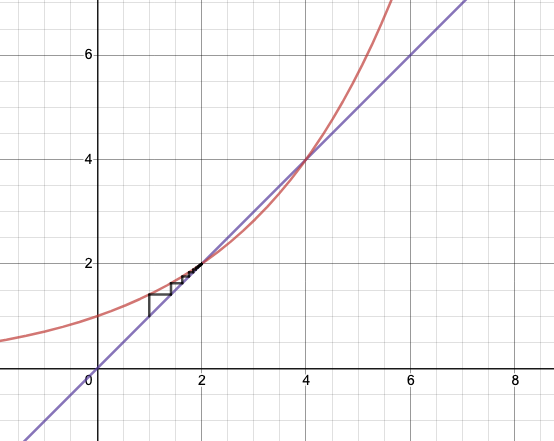 Figure 2: Power Tower for \(b = 2^{1/2}\)
- very simple but cool mathematics: consider the power tower \(x^{x^{x^x}}\)
- for \(x=2\), this blows up at the 6th iteration
- what about for \(x=1.1\)?
- my intuition was that this would also blow up pretty quickly, but nope.
- it basically stabilizes:
- solve \(x^{x^{\cdot^{\cdot^{\cdot}}}} = y\) for some constant \(y\), where \(x = 1.1\)
- note that by the property of \(\infty\), we have \(1.1^y = y\)
- so the limiting factor is the solution to that equation.
- if \(y=4\), what value of \(x\) converges to that?
- \(x^4 = 4 \implies x = \sqrt{2}\).
- but what about \(y=2\)?
- \(x^2 = 2 \implies x = \sqrt{2}\)…as well. oops.
- solve \(x^{x^{\cdot^{\cdot^{\cdot}}}} = y\) for some constant \(y\), where \(x = 1.1\)
- to see what’s going on, just look at Figure 1
- using the cobweb, which is a way to get a progression:
- \(a_0 = 1, a_i = b^{a_{i-1}}\)
- depending on the value of \(b\) (which defines the \(y=b^x\) graph), you’re going to get different behaviour
- the fun thing is that you can’t really tell this unless you draw the graph
- using the cobweb, which is a way to get a progression:
- in particular this (Figure 2) explains the weird thing that happens at \(\sqrt{2}\)
- the reason it doesn’t work is that when you set \(y=4\), and do the substitution of the power-tower on itself, that operation only works if it exists, but it doesn’t, so it’s illegal.
- if you could somehow do it in reverse, then you’d get the \(y=4\), maybe.