A Snide Comment about Certain Types of Research
tags: [ research , neural_networks ]
While cleaning out my Dropbox account, I stumbled upon a collection of papers I had saved, almost a decade back. While browsing one of them (The Pulse of News in Social Media: Forecasting Popularity: arXiv), I couldn’t help notice parallels with the current papers I’m reading regarding [[project-misinformation]].
What’s funny is that back in 2012, the state of the art was well summarized by Figure 1. And this aligned almost exactly with what we were taught in our ML class. And now, of course, every paper is basically using neural networks, which again matches the state of the art.
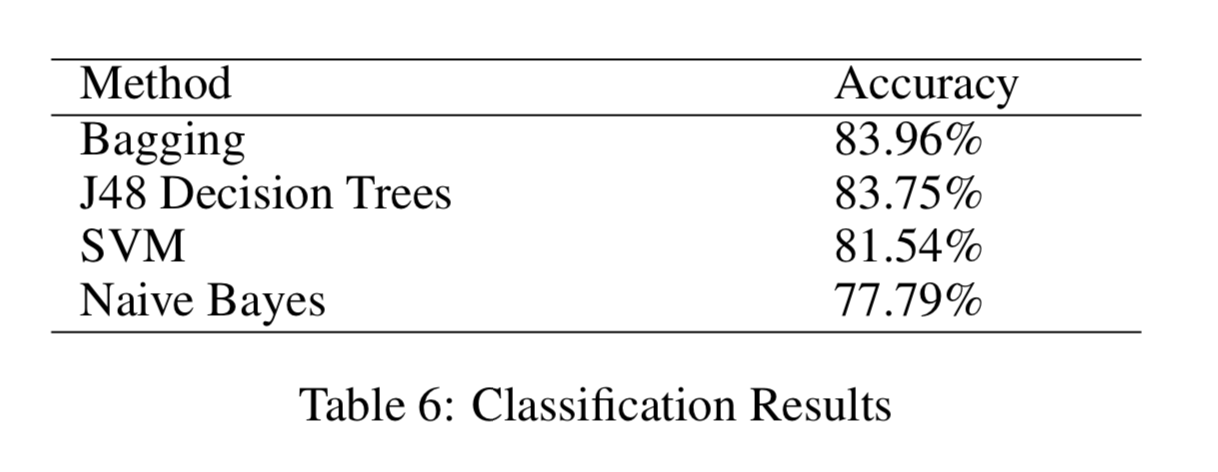 Figure 1: State of the Art in 2012!
I mean, at some level, this is just a comment about how ideas get circulated. Statistics and ML proffer methodologies that can then be applied to different problems to gain insight. It’s the natural sequence of events in science. At some other level, it sort of shows how derivative a lot of research really is. Of course, someone needs to apply the methods. And I guess people should be compensated for doing the labor (in the form of a publication).
I do think that something has changed in recent years. The flexibility of neural networks, and the need to play with the architecture, means that you can do cutting-edge research simply by trial and error. It has definitely moved more into the real of engineering. Another way to think about this is that, we used to worry about feature engineering, which is that you would spend a lot of time trying to create the right covariates to them input into your standard classification method. Now, we simply do feature-extraction engineering.