202007132341
Calculus for Brain Computation
tags: [ neuroscience , biologically_inspired ]
Figure 1: How fruit flies remember smells
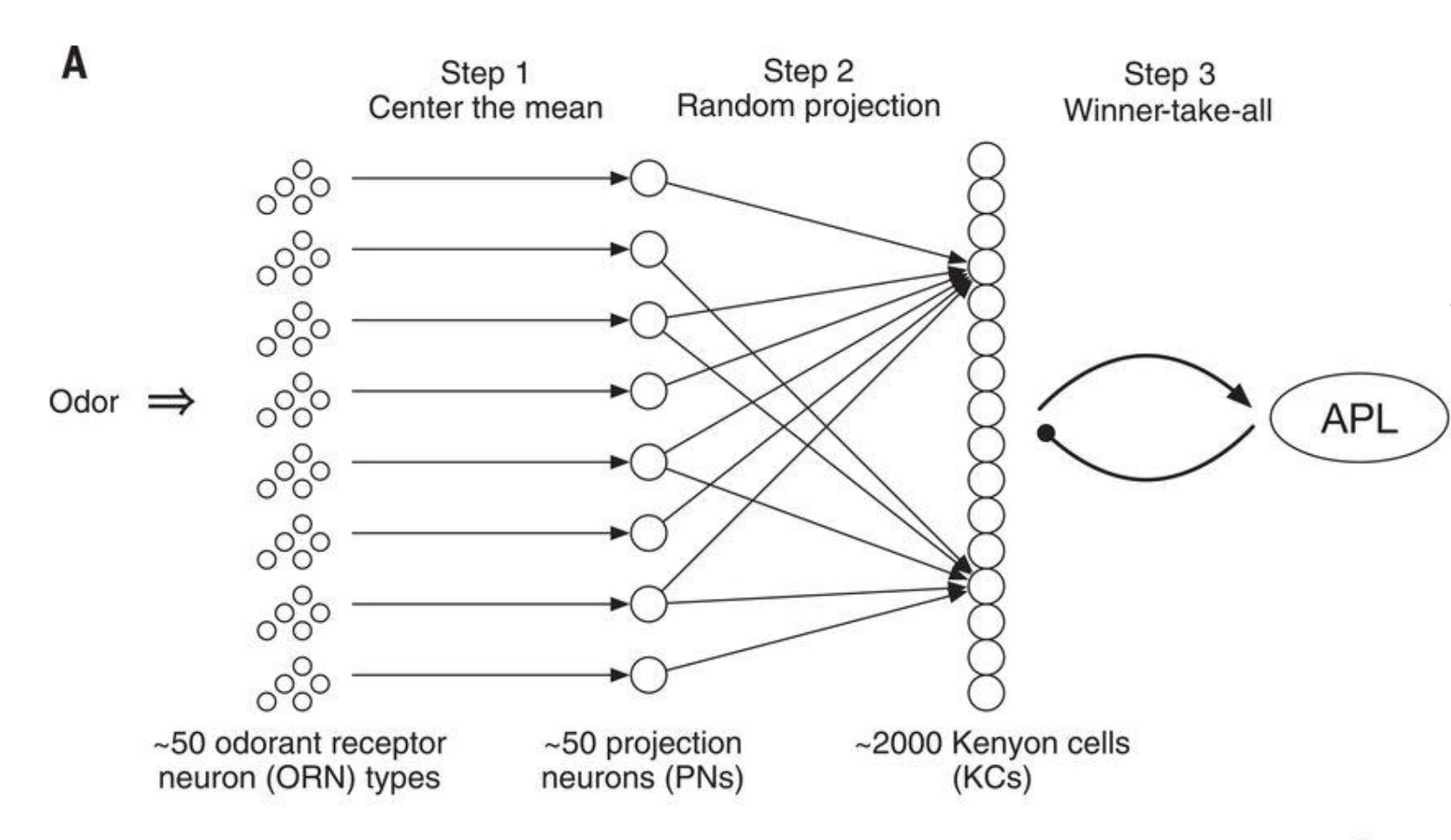
- olfactory intelligence: centering -> random projection (50 to 2000) -> sparsification
- \(\mathbb{R}^{50} \to \mathbb{R}^{2000} \to \{0,1\}^{2000}\) (sparsity at the 10% level, thresholding the top).
Figure 2: Random projection preserves similarity.
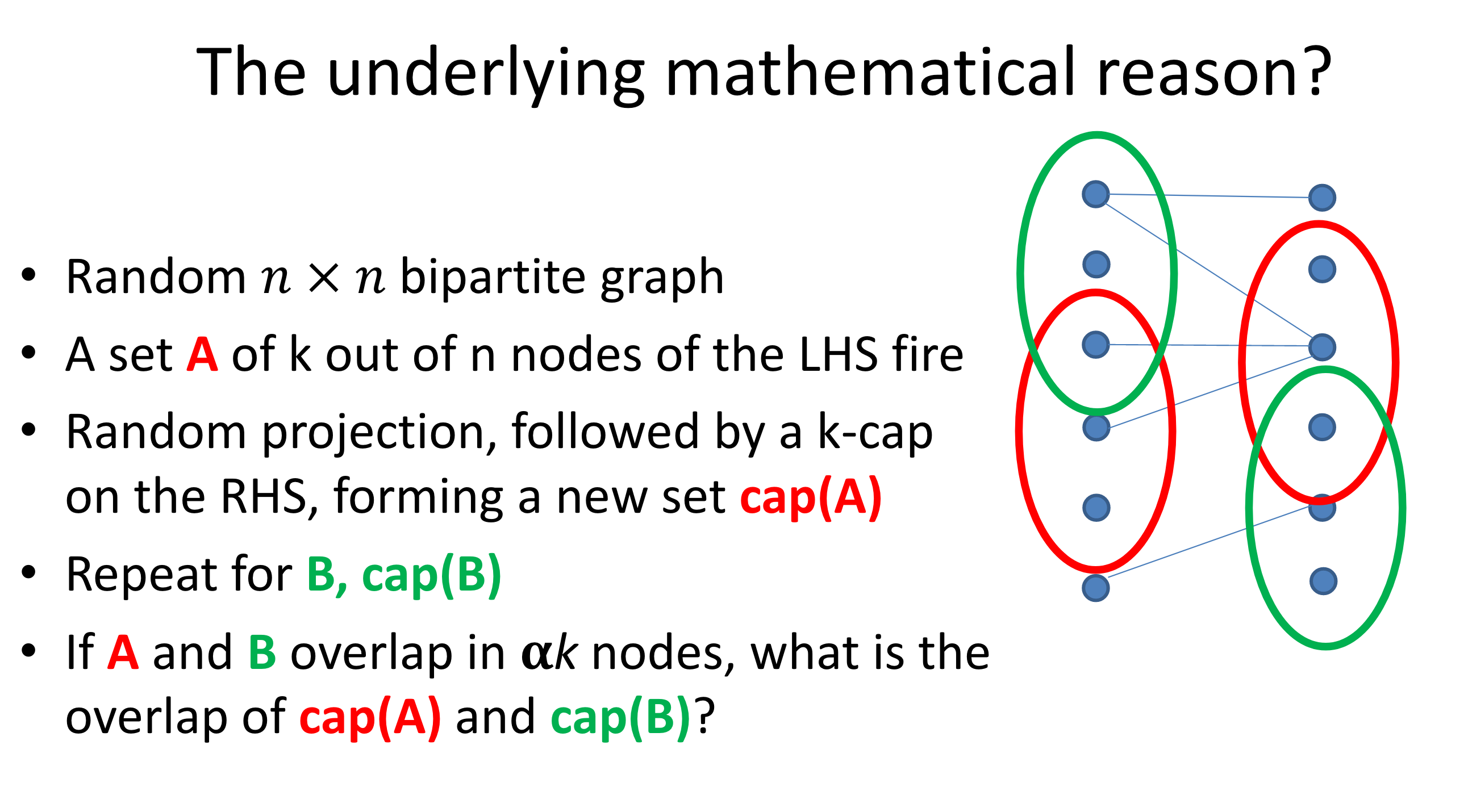
- similarity is preserved by this (random-projection+threshold) procedure; similarity here defined by overlap
- not really sure what you’re gaining though?1 I guess, the idea is that you have a sparse representation (binary vector that can be captured by binary-firing neurons). perhaps storage, like with computers, just has to be in binary, so there’s nothing particularly profound here.
- Calculus of the Brain
- interesting experiment: have a neuron only fire when you see eiffel tower (vs house or obama)
- then super-impose obama onto eiffel tower, Fig. 3
- now show Obama, and the neuron will fire (most of the time)
- what’s going on?
- one way you can think of this is that there’s the set of neurons that fire for eiffel (memory of eiffel), and similarly for other objects
- when you see two things together (learning relationships, causality, hierarchy), then what happens is that these two sets of neurons are now connected/merged
- but in order for this to make sense, the merge operation needs to be a little bit elaborate. basically you have to create the merged version (so like eiffel+obama), and perhaps that becomes the channel that connects the two things?
- this basically gives you something like a calculus on the brain, basically involving set operations on neurons
- interesting experiment: have a neuron only fire when you see eiffel tower (vs house or obama)
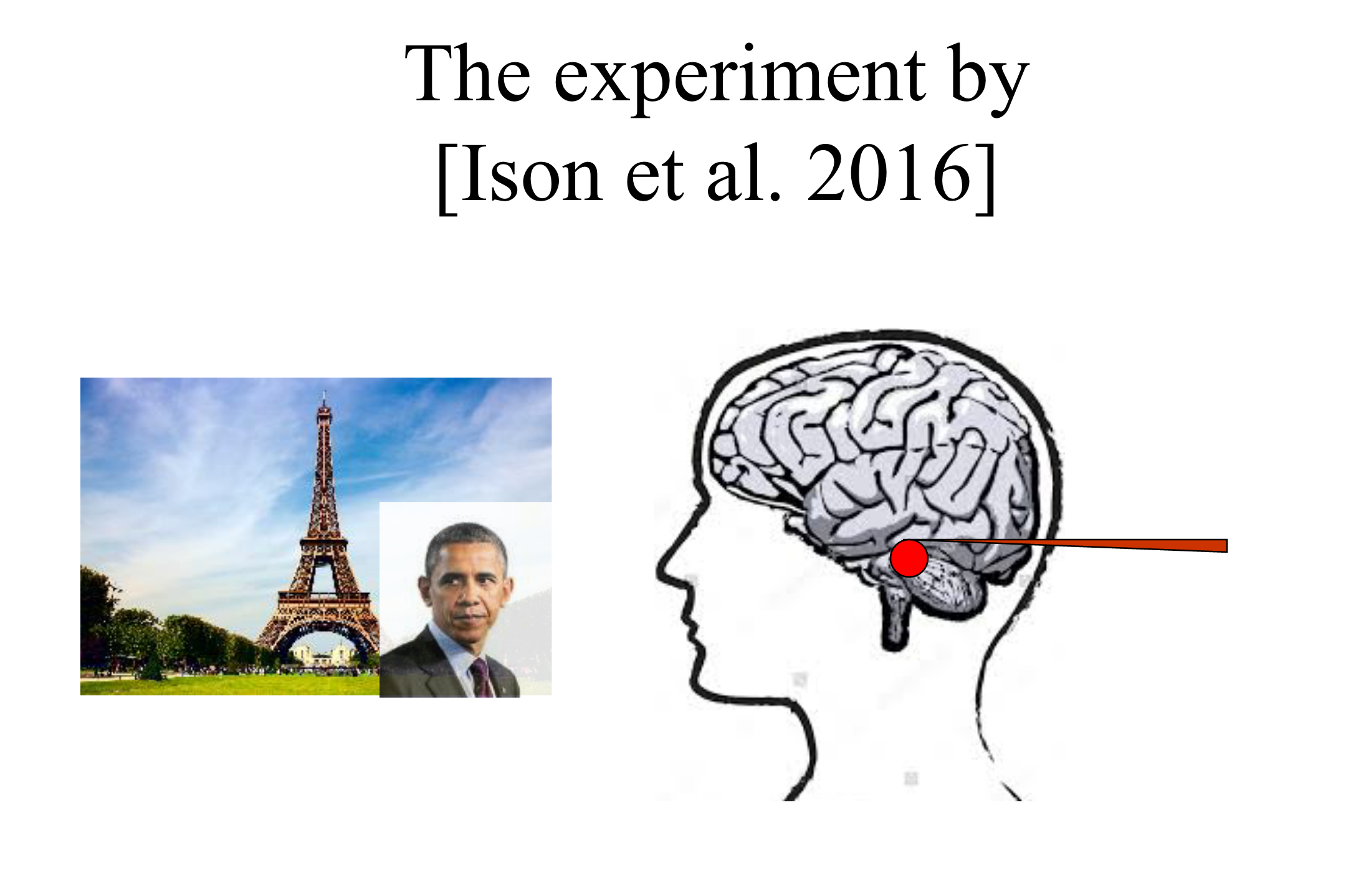 Figure 3: Ison et al. 2016 Experiment